← All articles

Explainer · 9 min · August 21, 2026

How Distressed Commercial Loan Review Actually Works

Roughly $930 billion in commercial real estate loans mature in 2026, and a growing share are distressed. Every one of them is a pile of documents someone has to read before deciding what it is worth. Here is how that review actually works, where the software stack helps, where it stops, and where judgment has to stay human.

Roughly $930 billion in commercial real estate loans mature in 2026, and by late 2025 distressed volume had already reached $126.6 billion, up 18 percent in a year. Those are big, quotable numbers. The part that does not make the headline is what each of those loans actually is on the ground. It is a folder. Sometimes a banker's box. Loan agreement, note, mortgage, assignments, appraisals, environmental reports, rent rolls, payment history, correspondence, and a stack of amendments, all of it written by different people at different times, none of it indexed.

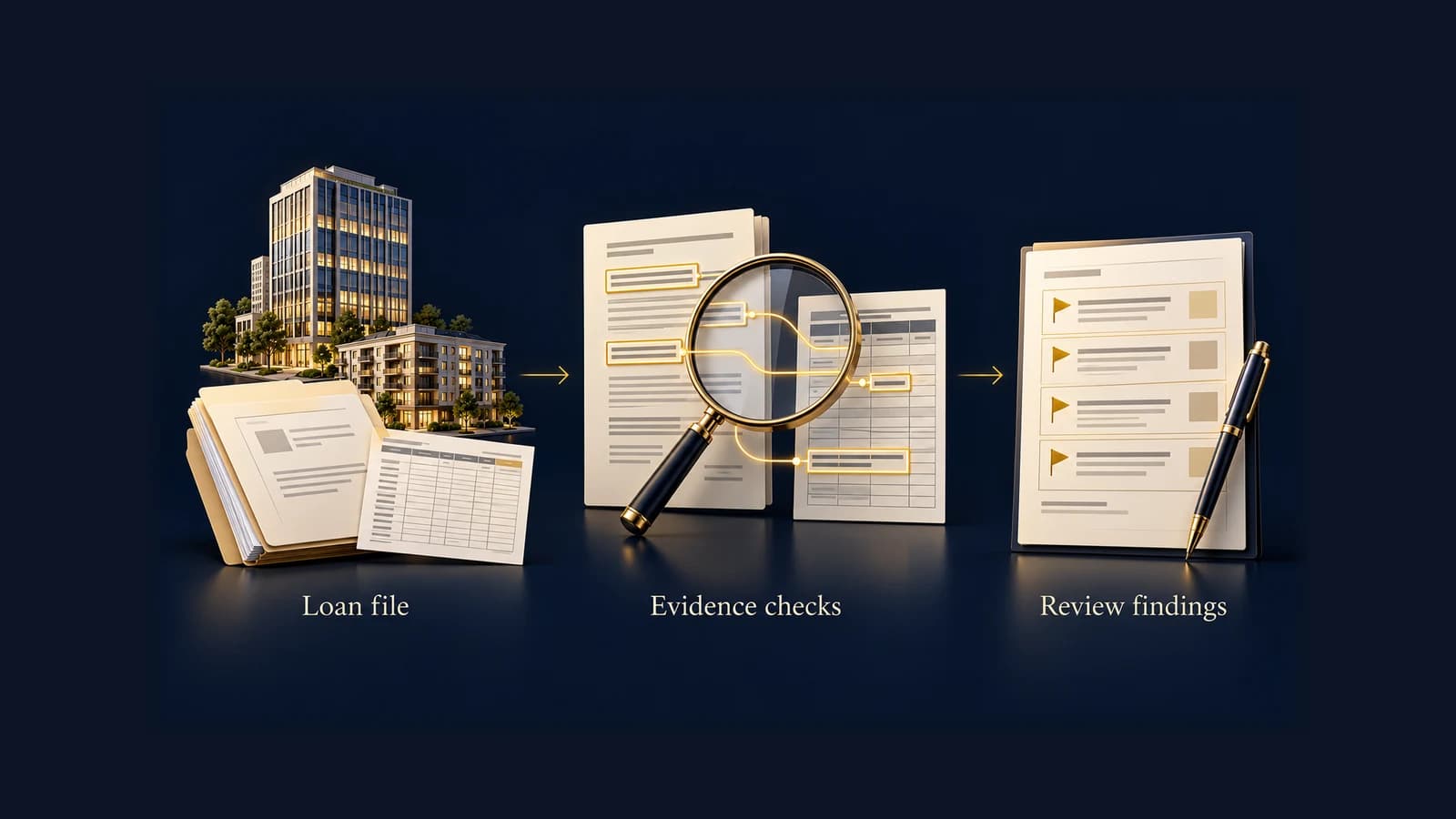
Before anyone can decide what a troubled loan is worth, someone has to read that folder. And the truth of this work, the part I keep coming back to, is that the hard part was never the decision. A person who has done this for thirty years can look at a loan and know what to do with it. The hard part is getting them to the point where they can look. It is finding the three sentences that matter inside forty documents. This is a walkthrough of how that review really works, where the tools help, where they stop, and where a human has to stay.

What distressed actually means

A distressed loan is one where the borrower stopped paying, called a payment default, or the loan came due and could not refinance, called a maturity default. The 2026 wave is mostly the second kind: low-rate loans that were extended for years and now have to face 6 to 7.5 percent refinancing.

There are two ways a commercial loan goes bad, and they are not the same problem. A payment default is the obvious one: the borrower stopped paying. A maturity default is quieter and, right now, far more common: the loan simply came due, and the borrower cannot refinance it at today's rates. Much of the 2026 wave is the second kind. Loans written in the low-rate years were extended again and again to avoid taking a loss, and all of that got pushed into one crowded window. Now those borrowers have to refinance into a 6 to 7.5 percent market, and a lot of them cannot.

When a loan lands in that spot, three different seats get involved, and each one is reading the same file for a different reason. Knowing which seat you are talking to changes the entire conversation.

The seatWhat they doWhat they need from the file
The bank or sellerWants the troubled loan off its booksA clean, complete package a buyer will trust and bid on
The buyer or investorAcquires the loan, often in a pool, to resolve itFast, accurate read of value and risk before bidding
The special servicerWorks the loan out after acquisitionEvery term, date, and obligation, straight and reliable

The bottleneck is the file, not the loan

The slow part of distressed loan review is not the decision. It is the file. A commercial loan can carry 20 to 50 document types, and reading, extracting, and reconciling them eats 60 to 70 percent of a reviewer's time per deal before any judgment happens.

Here is the number that explains the whole business. A single commercial loan file can hold 20 to 50 separate document types, and 60 to 70 percent of a reviewer's time per deal goes into reading, extracting, and reconciling those documents. Not deciding. Not negotiating. Just getting the facts out of the paper and lined up so a decision becomes possible. When a buyer is handed a pool of loans, that cost multiplies by the number of loans, and the clock is always running, because the seller wants bids by a date.

The industry has names for the pieces of this. The loan tape is the spreadsheet of loan-level data a buyer reviews to size up a pool. The data room is the online folder where all the underlying documents live. Abstraction is the act of pulling the key terms out of those documents and onto the tape. Every one of those steps is somebody reading carefully and typing accurately under time pressure, and every one of them is where a good deal quietly turns into a bad one, because a term was missed or a date was read wrong.

What a buyer is really hunting for

Two things at once: value and landmines. Value is what the collateral is worth and whether there is a path back to par. Landmines are title defects, broken covenants, and the buried email where a lender promised something and created liability. Missing one document can turn a good bid into a loss.

A distressed buyer is looking for two things at the same time, and they pull in opposite directions. The first is value. What is the collateral actually worth today, what does the payment history really show, and is there a credible path back to par or to a profitable resolution. The second is landmines. A title defect that clouds the collateral. A covenant that was breached and papered over. And the one everyone in this world respects, the buried email or letter where a lender made a promise or a representation that creates liability. Reviewers call that the smoking gun, and finding it before you bid is the difference between a return and a lawsuit.

This is why the review cannot be sloppy and cannot be skipped. The value case lives across the appraisal, the rent roll, and the payment record. The risk case lives in the fine print and the correspondence, the places nobody reads until it is too late. A buyer who can see both, quickly and completely, can bid with confidence and move on more loans. A buyer who cannot is either overpaying or walking away from deals they should have won.

Where the software helps, and where it stops

Debt and acquisition platforms track the checklist, the loan terms, and covenant breaches well. What they do not do is read the actual documents and pull the evidence out. They tell you the box is checked. They do not tell you what the document says or where the fact lives.

The stack in this world is real and it is good at what it does. Platforms like Yardi Debt Manager centralize loan terms, rates, and payment schedules, and Yardi's Acquisition Manager tracks due diligence checklists and deal workflows with real-time updates and covenant-breach alerts. If your problem is knowing what is done, what is missing, and whether a financial covenant just tripped, that problem is solved. Yardi Matrix will even help you scan a market for loans by maturity and balance to find distressed opportunities in the first place.

But notice the exact shape of what those tools do. They track the checklist. They tell you the appraisal is checked off, the environmental is received, the covenant is breached. What they do not do is read the appraisal and tell you what it says, or surface the sentence in the loan agreement that changes the number, or point you to the email that becomes the smoking gun. That is the gap between tracked and read. The checklist tells you a document exists. It does not tell you what is inside it. And inside is where the money and the risk actually are.

The line regulators just drew

New lending governance rules require tracing AI-generated loan data from its source document, through validation, through human review. In plain terms, the compliant way to use AI in loan review is to organize and cite the evidence, not to make the call.

There is a reason I am careful about how AI gets used in a file like this, and as of this month it is not just caution, it is the direction the rules are moving. New AI governance requirements in lending now push lenders to trace any AI-generated loan data from its source document, through validation, through human review, and into the system of record. The point is auditability. If a machine produced a fact, you have to be able to show where it came from and who checked it.

Read that against how most people imagine AI in finance, the model that reads everything and tells you what to do, and you can see why that version is a non-starter here. The exposure is legal and financial, and a confident answer with no traceable source is a liability, not a shortcut. The compliant version is the opposite. Organize the evidence, cite every fact back to the page it came from, and leave the decision to the person who is accountable for it.

What good actually looks like

Evidence organized, every fact linked back to the exact page it came from, and the reviewer still making every decision, only now across more loans without taking on more risk. Organize the evidence. Keep the judgment human.

Picture the same troubled loan, reviewed a better way. The file goes in, and what comes back out is the evidence organized: the key terms, the dates, the covenants, the payment story, and the red flags, each one linked back to the exact page it was pulled from. Nothing is summarized into a black box. Every fact has a receipt. The reviewer does not read forty documents to find the three sentences that matter. The three sentences are already in front of them, with the pages behind them one click away.

The reviewer still makes every call. That does not change, and it should not. What changes is the reach. The same experienced person can now look at more loans in the same week, bid with the same confidence on all of them, and take on no extra risk in the process, because nothing was hidden and everything is sourced. That is the whole idea, and it is small enough to say in one line. Organize the evidence. Keep the judgment human.

Common questions

Answers to what people ask.

What is distressed commercial loan review?

It is the process of reading and evaluating the full file on a commercial real estate loan that is in trouble, either because the borrower stopped paying or because the loan came due and could not refinance. A buyer, a bank, or a servicer reviews the loan documents, the collateral, and the payment history to decide what the loan is worth and how to resolve it.

Why is reviewing a distressed loan so time consuming?

A single commercial loan file can hold 20 to 50 different document types. Industry estimates put 60 to 70 percent of a reviewer's time per deal into reading, extracting, and reconciling those documents before any judgment is even possible. The work is not the decision. It is getting to the point where a decision can be made.

Can AI decide which distressed loans to buy?

No, and it should not. The defensible use of AI here is to organize the evidence and point every extracted fact back to the source document, so a human reviewer can decide faster and across more loans. New lending governance rules push in exactly this direction: trace AI output to its source, keep a human in the loop.

Where does software like Yardi fit in distressed loan review?

Platforms like Yardi Debt Manager and Acquisition Manager are strong at tracking the due diligence checklist, loan terms, and covenant compliance. They tell you an appraisal is checked off. They do not read the appraisal and tell you what it says or where the number came from. That gap between tracked and read is where deals get mispriced.

Next step

Reviewing a pool and running out of hours?

Bring one problem loan's file. We will organize the evidence in front of you, link every fact back to the page it came from, and leave the decision where it belongs, with you. If it does not save you real time, we will say so.

Christopher J. Moreno

Written by

Christopher J. Moreno

Chris is a solo AI consultant with five documented systems across construction, roofing, and Medicare insurance, every number on them measured before it was published. He builds operating systems for real businesses that need cleaner intake, clearer follow-up, and less invisible admin drag.

Our methodology

The Flo OS in practice

The approach behind this work follows the four phases of Flo OS, our operating methodology for turning messy business workflows into systems that run cleanly and compound over time.

See how we work →

Related reading

Keep reading.

All articles