Book a call ↗

Home services · 6 min read · September 28, 2026

What Happens to a Roofing Company's Missed Calls, and How They Become Booked Inspections

The receptionist answers the phone. The harder question is what happens to everyone who called, filled a form or texted and did not book. Here is how A&J Professional Services' follow-up lanes work, and what measuring them turned up.

How should a roofing company follow up on calls and leads that did not book?

Give every lead that did not book one lane, and in that lane exactly one of three things: a planned next text or email, a named reason to stop, or a pause a person chose. Check it every morning. At A&J, the gaps were permission and missed replies, not missing software.

A&J Professional Services is a roofing and exterior contractor in New Jersey. I build their systems from here in Tampa Bay, and the first one was Sarah, the voice receptionist that answers when the crew is on a roof. You can watch her walkthrough. Answering the phone turned out to be the easy half.

In late September I measured what happened to everyone who reached out that month and did not book on first contact. I read the real records without changing anything. The painful finding was a group of open leads with neither a planned next message nor a recorded reason to stop. Nobody had lost them to a competitor. They were simply nobody's job.
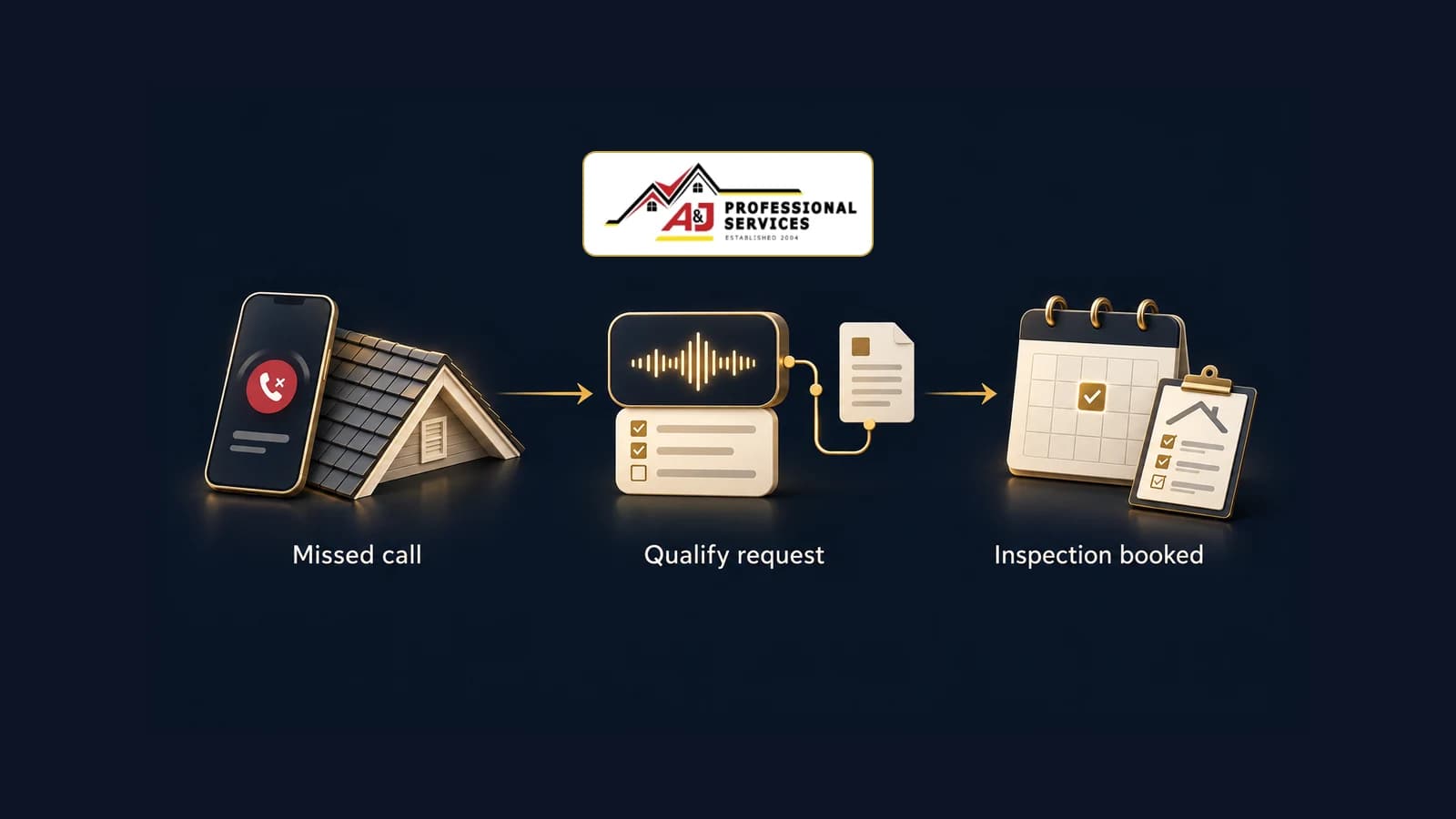
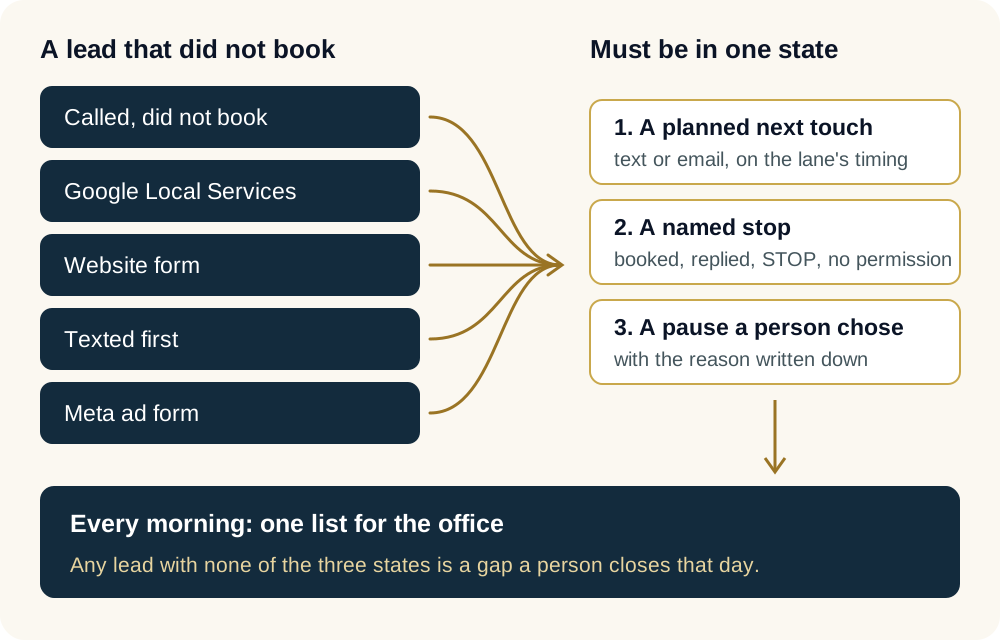
Diagram: a missed call to a roofing company goes through a qualifying step and ends as a booked inspection, with the A&J Professional Services logo above it.
Where every missed call should end: qualified, then booked for an inspection. The rest of this article is about the calls that do not get there on the first try.

Related case study

A roofing receptionist that answers at 2am and will never quote a price

A&J Professional Services is a family-owned roofing and exterior contractor. When the owners are on a roof, the phone goes to voicemail, and the homeowner calls the next contractor. We built a voice receptionist that answers, qualifies the job the way their estimator would, and books the inspection. It is live on their line and backed by 512 passing tests and a written call-quality rubric.

See our work

Five lanes, one rule

Every lead that did not book goes into exactly one lane by how it arrived: called and did not book, Google Local Services, the website form, texted first, or a Meta ad. Each lane keeps its own timing. The rule across all five is the same: a next step, a named stop, or a pause.

The fix starts with sorting. Every lead that did not book goes into exactly one lane based on how it arrived, because a homeowner who filled out a form expects something different from one who called while the office was closed. Each lane keeps the timing the business already used.

Then one rule applies to all of them. At any moment a lead has a planned next text or email, a named reason to stop (booked, replied, asked us to stop, no permission to text), or a pause a person chose and wrote down. A lead with none of the three is a gap, and the system lists the gaps for the office each morning.

Diagram: five lanes (called and did not book, Google Local Services, website form, texted first, Meta ad form) feed into three allowed states (a planned next touch, a named stop, a pause a person chose), and a morning list shows the office any lead with none of the three.
Every unbooked lead sits in one lane and one of three states. The morning list is the only thing a person has to read.

What measuring it turned up

The messaging mostly worked. Callers were stuck on permission, because a phone call is not consent to be texted. A few replies sat for more than a week with nobody acting, and one ladder of follow-ups was not carrying leads forward at all.

I expected broken automation. Mostly I found permission and attention. The follow-up never texts someone who only called, and it should not, so callers sat with a stop reason of no text consent and no other path. A few leads replied and nobody acted for more than a week. Several planned follow-ups were sitting in held or draft past their date. And one lane's ladder of messages was not carrying leads forward at all.

Speed was not the problem people assume. Text-first inquiries and Meta leads got an answer within seconds. The first texts that looked slow had mostly landed outside daytime hours, when waiting until morning is the polite thing to do.

Why a phone call is not permission to text

Federal rules require the phone owner's consent before an autodialed text reaches a mobile number, and commercial texts need written consent. So text permission gets its own box on the form, and what to do for callers who never gave it is the owner's decision.

The FCC's consumer guide is plain about it: autodialed texts to a mobile phone need the owner's prior consent, and commercial texts need written consent. A homeowner calling about a leak has not agreed to a text campaign.

So the website form asks for text permission in its own box, separate from the request, unchecked and optional. What to do for callers who never gave it is a business decision, and at A&J it is still open with the owner. I would rather leave that door shut than pretend software can answer a consent question.

An email reply has to count as a reply

The follow-up read calls, texts and its own sends, and never the email inbox. A homeowner who answered by email was invisible, so the ladder kept talking over them. The fix, built and tested, counts every reply by any channel.

This one stung. The follow-up read calls, texts and its own sends to decide whether someone had answered. It never read the email inbox. A homeowner who replied to the booking email was invisible, and every ladder kept talking over them. That is exactly how a helpful system becomes an annoying one.

The fix counts a reply on any channel. While building it I found the booking confirmation emails had been failing because two labels on each message shared the same name, and the email service rejected them. The texts had gone out, so nobody noticed. Both fixes are built and tested and ship with the follow-up lane.

What stays with a person

Every sentence a customer will read. New wording is held until it is approved, each switch stays off until a preview run, and messages and calls still go through the existing sender and dial door.

Every sentence a customer will read. The new lane messages are written and held until they are approved. Each switch ships off and stays off until one preview run on real records. And every message still goes through the existing sender, and every call through the existing dial door, which refuses do-not-contact numbers and quiet hours. The lanes plan the next step; they do not get a second way to reach anyone.

Where it stands, honestly

The lanes are built, tested on the real lead list without sending anything, and live on the dashboard with their switches off. In a local run against the real records, one complete journey worked end to end on a test phone, with nothing able to reach a real customer. I am not giving you a booking-rate number, because the honest before-number does not exist yet, and a percentage built on a guess would be worse than none.

When this is the wrong move

If you book almost everyone on the first call, fix nothing here. If nobody will read the morning list, the lanes only make a longer list. And if your phones go to voicemail during the day, start with how calls become booked jobs before worrying about follow-up.

Common questions

Answers to what people ask.

How fast should a roofer follow up on a web lead?

Fast, inside sensible hours. In A&J's system a text-first inquiry and a Meta ad lead get a reply within seconds. When a first text looks slow, it is usually because the lead arrived at night and the system waited for daytime, which is the right call for a homeowner.

Can I text a homeowner who called but did not book?

Not on the strength of the call alone. The FCC says autodialed texts to a mobile phone need the owner's prior consent, and commercial texts need written consent. Ask for text permission in its own box on your forms, and decide with your own counsel how to reach callers who never gave it.

What if the customer answers by email instead of text?

It has to count as a reply, and the sequence has to stop. We found A&J's follow-up could not see email replies at all, so a homeowner who answered the booking email kept getting messages. The fix is built and tested: an email reply stops the ladder like any other reply. It ships with the rest of the lane.

Does this replace the office staff?

No. It gives the office one list each morning of leads that have no next step, no stop and no pause, and it keeps every message a customer reads under a person's approval. The office still makes the calls that matter.

Sources

Where this comes from.

Next step

Leads that called once and went quiet?

Bring last month's leads. We will sort them into lanes with you and show which ones have no next step today, before anything is built.

Christopher J. Moreno

Written by

Christopher J. Moreno

Chris Moreno builds custom AI systems for business operations. His writing draws on the work behind these systems: intake, follow-up, document workflows, and the checks that keep people in control.

Published September 28, 2026 · Connect on LinkedIn

Our methodology

The Flo OS in practice

The approach behind this work follows the four phases of Flo OS, our operating methodology for turning messy business workflows into systems that run cleanly and compound over time.

See how we work →

Related reading

Keep reading.

All articles