Book a call ↗

Real Estate · 6 min read · September 26, 2026

What Automating a Due Diligence Review Taught Me About Commercial Real Estate

A deal team's inbox fills with offering packages, rent rolls and follow-up emails, and the reasons behind every yes or pass live in a few people's heads. Here is what building deal screening with Dallas Whitaker of Carter Funds taught me about where automation starts.

Where should a commercial real estate firm start automating due diligence?

Start with the screening decision. Write the fund's criteria down so they can be versioned, grade any screener against deals the team actually pursued, and give every document one home the company owns. Building deal screening with Dallas Whitaker of Carter Funds, those three steps shaped the work before any automation mattered.

Picture a small commercial real estate team on a Monday. Offering packages, rent rolls and broker follow-ups arrive by email all week, and every one has to be read against the fund's strategy before anyone decides whether it deserves a second look. The reasons a deal got a yes, or a pass, live mostly in two or three people's heads. When one of them is out, the next deal starts from zero.

That was the world I stepped into building deal screening with Dallas Whitaker, a decision maker at Carter Funds, a commercial real estate firm here in Tampa Bay. The volume is not going down: MSCI estimates over $930 billion in commercial real estate loans come due in 2026, and every refinancing, sale and workout is another file for a small team. What follows is what the work taught me, in the order I learned it.
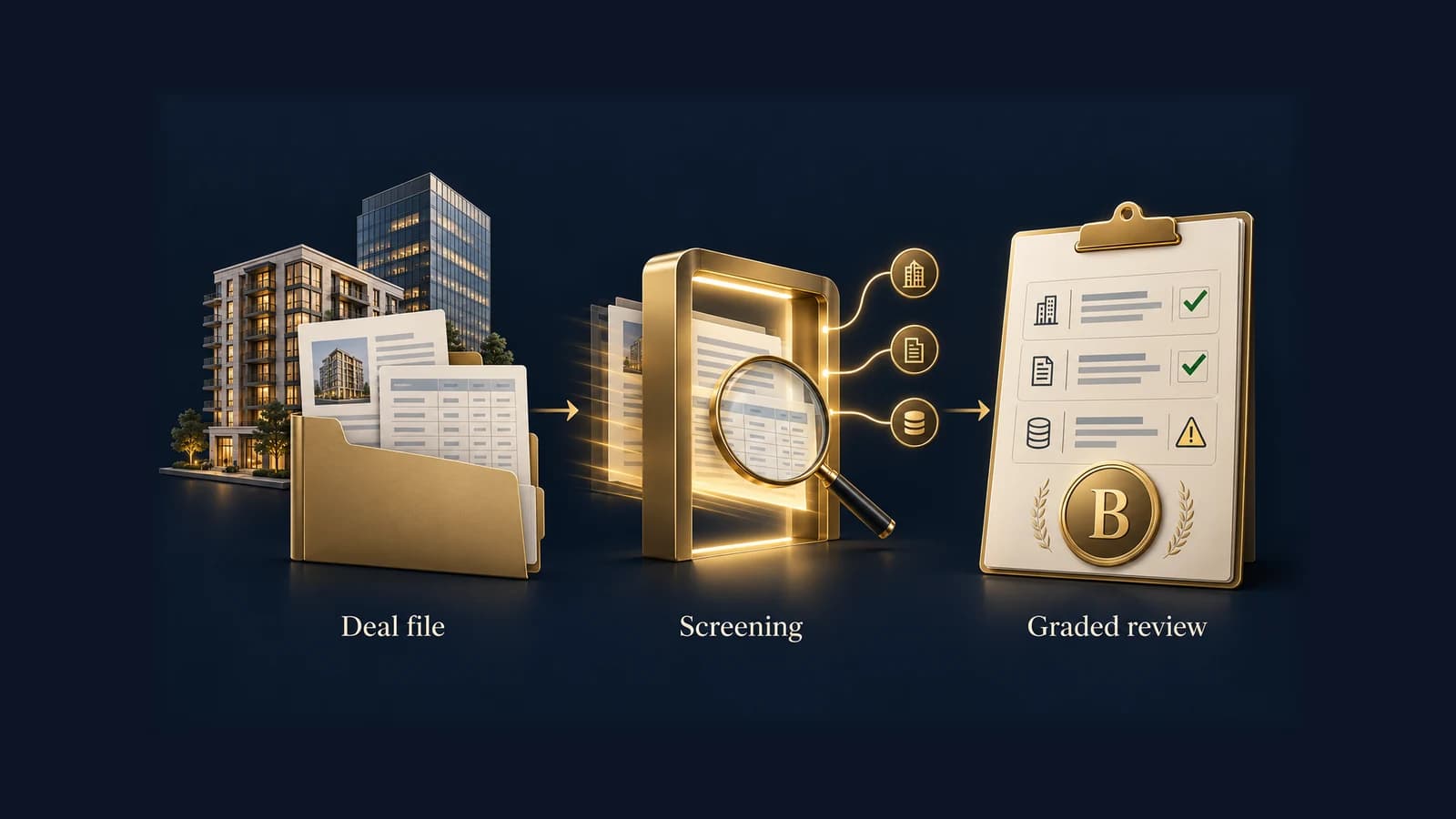
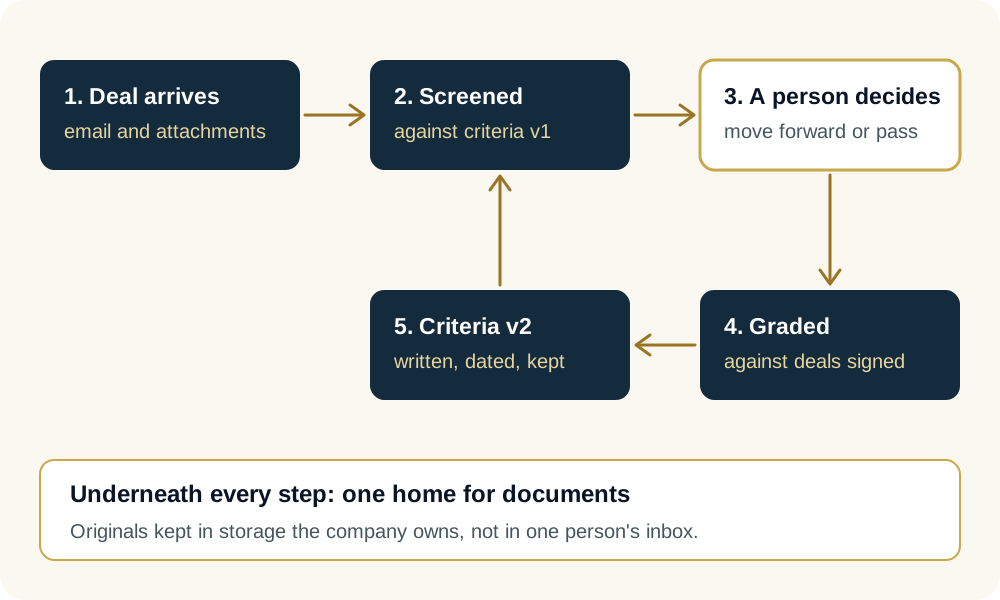
Diagram: a commercial real estate deal file goes through a screening step and comes out as a graded review for a person to check.
A deal file in, a graded review out, and a person decides. The letter grade is drawn for illustration, not a real deal's score.

The criteria lived in people's heads

A screener can only be as good as the rules it is given. The first job was writing the fund's criteria in plain words, with a version number, so that when the rules change you can tell which version judged which deal.

Every fund says it has criteria. Ask to see them written down and you usually get a mix of a pitch deck slide, a few emails and the managing partner's instinct. A person can work from that. A screening system cannot, and neither can a new analyst.

So the first real deliverable was a document: the fund's criteria in plain words, each version dated, so a score on any deal could be traced back to the exact rules that produced it. The criteria belong to the fund. How the screener is graded against them is the part I bring.

Grade the screener against deals the team actually pursued

An accuracy claim means nothing until it meets a real decision. Start with a deal the team signed and ask whether the screening step would have flagged it. Then keep grading, one criteria version at a time.

Here is the moment that changed how I work. In July, the screening step had scored a deal at zero. It was the one deal the team went on to sign. The system had been running, producing scores, looking busy, and it would have buried the one deal the team went on to sign.

Nothing was broken in the usual sense. The criteria it was given simply did not describe what the team valued in that deal. The only way to catch that is to grade the screener against real decisions, starting with every signed agreement, and to keep grading each time the criteria change. A score you have never checked against an outcome is a guess with a number on it.

Diagram of the deal screening loop: a deal arrives by email, is screened against criteria version one, a person decides, the screener is graded against deals signed, and the result becomes criteria version two, with documents kept in company-owned storage underneath every step.
The loop the engagement was built around. The person in step 3 decides; the grading in step 4 is what makes version 2 better than version 1.

One home for every document

Documents scattered across inboxes are why the next deal starts from zero. Originals get a second home in storage the company owns, so the file outlives any one person's mailbox.

Due diligence produces paper: offering memoranda, rent rolls, operating statements, loan documents. In most small firms those files live in whoever's inbox they landed in. That works until someone leaves, or until the team needs to compare this deal with one from last spring.

The fix is boring and does more than any model: originals get a second home in storage the company owns, named consistently, linked to the deal they belong to. Everything else in the system reads from there.

Write down who owns data, access and backups

Say it before the build, not after an incident: who can query the data, who holds the credentials, who keeps the backups and who fixes a change someone else made.

The part of the proposal I rewrote the most was the clause on data, access and responsibility. Anyone the company admits can query the database directly. Access, credentials, backups and changes made by other people are the company's to manage, and correcting someone else's change is separate work.

That sounds cold on paper. In practice it is what lets an owner trust the system, because nobody is guessing later about who should have kept the backup. The same thinking sits behind a line I now put in every agreement: the client owns its data, criteria and outcomes, and I keep my methods.

Fixed scope, explained in detail

Dallas wanted every deliverable explained in detail before the next step, and he was right to. The first worry on the table was monthly cost, before accuracy even came up. So the work was split into fixed modules with the hours shown on each, a clear list of what done looks like, and acceptance a set number of business days after handover.

The lesson for any firm hiring help: if a consultant cannot tell you what each piece costs to run and how you will know it is finished, the scope is not ready.

What stays with a person

The investment decision. A screener sorts and flags; a person moves a deal forward or passes. Nothing the system produces is advice.

The investment decision. A screener sorts incoming deals and flags the ones worth reading first; a person moves a deal into the pipeline or passes. The system also does not give investment advice, and the agreement says so.

When this is the wrong move

If the partners do not agree on the criteria yet, automate nothing and write the criteria first. If the firm sees a handful of deals a month, a good analyst and a shared folder will beat any system. And if nobody will own the documents, the screener will only move the mess faster.

Where I would start next time is where the next audit, at Carter Funds itself, starts: recorded conversations with the people who do the work today, and one real example of each document they touch.

Common questions

Answers to what people ask.

Can AI screen commercial real estate deals?

It can sort incoming deals against the criteria a fund has written down and flag which ones a person should read first. It cannot make the call. Grade it against deals your team actually pursued before you trust its scores, and grade it again every time the criteria change.

What should a CRE firm prepare before automating due diligence?

Four things: the screening criteria in plain words with a version number, one real example of each document the team reviews, recorded conversations with the people who do the review today, and a company-owned place where originals will live.

Who owns the data when a consultant builds the system?

In my engagements the client owns its data, its criteria, its calls and its outcomes. CMore Flo keeps its methods, such as how a screener is graded. Write that split into the agreement before the build starts, along with who is responsible for access, credentials and backups.

Sources

Where this comes from.

Next step

Reviewing deals by inbox and memory?

Bring your criteria, even if they are only in your head, and one deal you signed. We will write the criteria down together and check whether a screen would have caught that deal.

Christopher J. Moreno

Written by

Christopher J. Moreno

Chris Moreno builds custom AI systems for business operations. His writing draws on the work behind these systems: intake, follow-up, document workflows, and the checks that keep people in control.

Published September 26, 2026 · Connect on LinkedIn

Our methodology

The Flo OS in practice

The approach behind this work follows the four phases of Flo OS, our operating methodology for turning messy business workflows into systems that run cleanly and compound over time.

See how we work →

Related reading

Keep reading.

All articles