
Book a call

Home services · 6 min read · October 10, 2026

How We Automated a Roofing Company's Growth Operations: Calls, Ads, Search, Content and Quoting

Everything we built for A&J Professional Services, a roofing company in New Jersey, in the order we built it: the receptionist, the ad cleanup, the website and reviews, the content engine and the quoting work. What is live, what is not, and what the owner says happened to the business.

How do I automate the growth side of a roofing company?

Start with the phone, because every other channel ends in a call. Answer and book every call, then clean up paid search, then protect the website and reviews, then automate content behind an approval step, and only then automate quoting. Measure each step by booked inspections and collected payments, not clicks or posts.

A&J Professional Services is a roofing and exteriors company in South Plainfield, New Jersey. Christian is one of its owners, and I have been building their systems since June 2026. In his own words, recorded for his testimonial: "Literally doubled, almost tripled our revenue." That is his report of the whole business, not an audit, and I do not claim every dollar came from what we built.

What we measured ourselves is narrower. Company-wide cash collected went from $42,956 in June 2026 to $177,313.40 in August, from all sources. Separately, $108,423.40 was paid on 13 jobs that we could match to bookings our receptionist made. Both figures were verified on September 15, 2026 from the company's payment records. The full film and the measurement notes are public.

Here is everything we built, in the order we built it, including the parts that are not finished. If you run a roofing company, you can copy the order even if you never hire anyone.

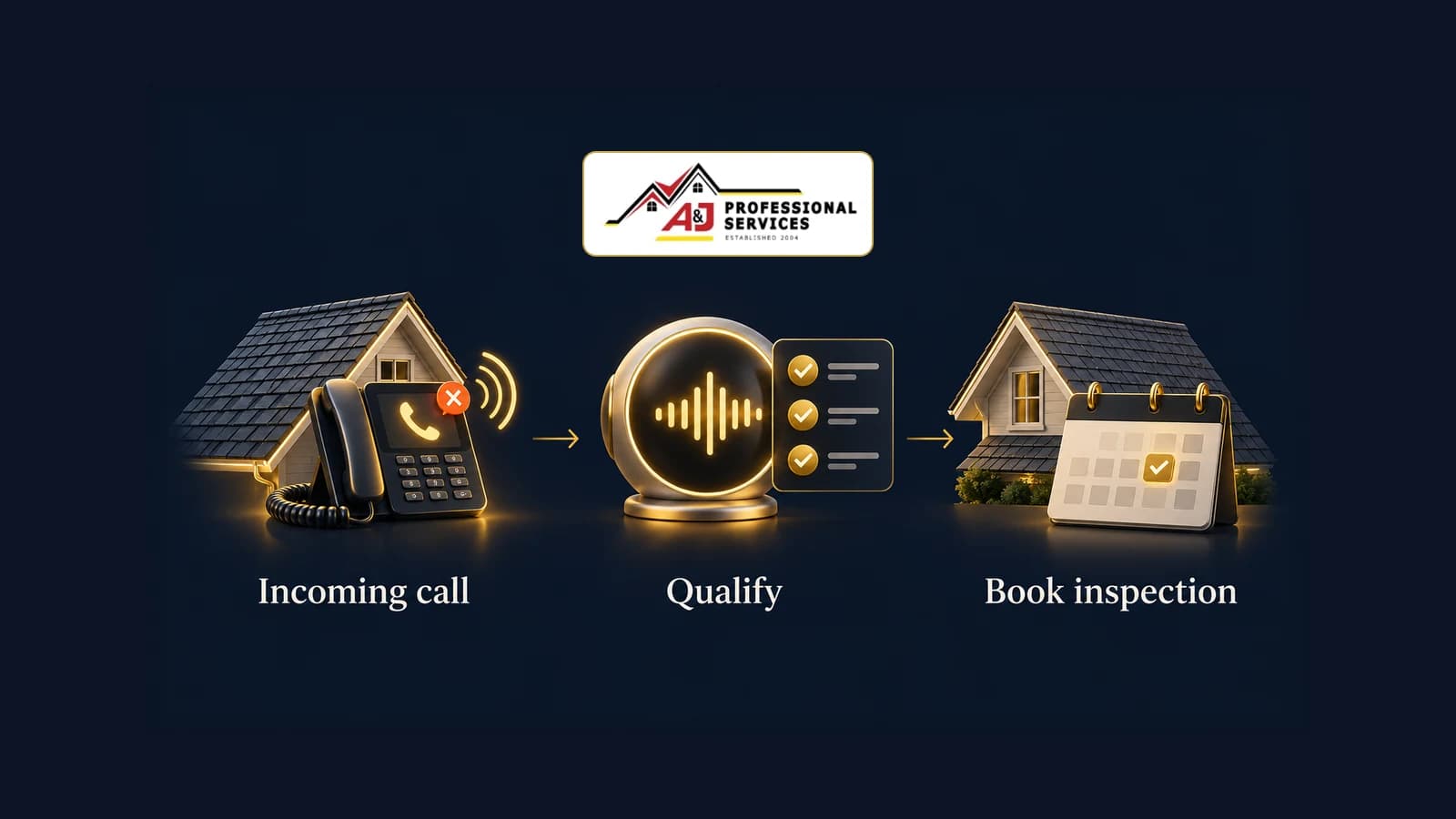
Step 1: answer every call and book the inspection

Sarah, the AI receptionist, went live on July 23, 2026. She answers, qualifies, books the inspection into the company calendar and texts the caller. A person picks up anything she can not handle.

Before anything else, the phone. A roofer is on a roof when the phone rings, and the caller with a leak calls the next company on the list. Every dollar spent on ads or search is wasted on a call nobody answers.

Sarah is the AI receptionist we built for A&J. She went live on July 23, 2026. She answers, asks what an estimator would ask (what is wrong, what kind of property, whether the caller owns it, whether it is in the service area), books the inspection into the company calendar and sends the confirmation text. In August she wrote 52 entries on the schedule; 39 stayed booked, five were cancelled and eight were removed. We did not verify attendance, so I do not count those as jobs.

The detail is in how a roofing company's calls become booked jobs and what happens to the calls that do not book.

Step 2: stop paying for searches that never become jobs

Read what people actually typed, block the junk with negative keywords taken from that list, and judge the result by booked inspections. A smaller campaign that books jobs beats a bigger one that does not.

Next, the money already going out. A&J's Google Search campaign ran on broad match, which lets Google decide which searches are close enough. When we read what people actually typed, more than half of the visible spend had gone to searches that could never become a roofing job: supply stores, do-it-yourself questions and other trades.

We built 31 negative phrases from the account's own report and moved the keywords to phrase match. Spend on the blocked searches went to zero. The full method is in how to read a Google Ads search terms report as a roofer.

One lesson from Local Services Ads, the pay-per-lead listings at the top of Google: Google paused A&J's listing from August 21 to September 4, 2026. If you compare months without knowing that, the drop looks like your fault. Read lead channels week by week and write down anything the platform did on its own.

Step 3: protect the website and the reviews

In late August we moved A&J's website off Webflow onto a site the company owns. A move like that can quietly throw away years of search history. We captured all 97 addresses Google knew before the move and checked every one answered afterwards. The checklist is in how to move a roofing website without losing its search history.

Reviews are part of search too. The old site said 245 Google reviews. When we read the Business Profile directly it said 247, at 4.8 stars. Small, but a number on your own site that does not match Google is the kind of thing a careful buyer notices. We corrected it from the live Google reading.

Step 4: automate content, with a person approving it

This is the part people ask about most, and the part with the most honest caveats. Google lets you automate Business Profile posts, review replies and YouTube uploads through its APIs. To use them you set up a project in the Google Cloud console, connect the company's own accounts and ask Google for access. YouTube access for A&J worked. Business Profile access is a separate request that Google reviews by hand, and as of October 2026 it is still pending.

So the content jobs are being built switched off. A weekly Business Profile post and a review-reply draft each sit behind their own off switch, and each one waits in an approval queue for a person before anything is published. None of them is switched on yet, and publishing is still done by a person. I would rather tell you that than show you a dashboard of posts nobody approved.

If you want to try this yourself, start with the approval step, not the automation. A post that goes out wrong in your company's name costs more than the hour it saved.

Step 5: quoting comes last, on purpose

Quoting is the step where a wrong number costs the most. It waits until the company's own past estimates and supplier orders are joined, so the system learns from what the company actually charged.

Estimating is where a wrong number costs the most, so it is the last thing we automate. Before any AI drafts a roofing quote, we are joining the company's own history: 485 past estimates in its CRM and the supplier orders behind them. That work is underway and nothing drafts quotes for customers yet. The full story is in how to automate roofing estimates.

What went wrong, so you can skip it

Two mistakes are worth more to you than the wins. First, a one-character mistake in our code (a customer record number sent as a number instead of as text) silently blocked every outbound follow-up call from August 14 to August 26, 2026. The system logged it as a consent problem, so it looked like a rule working. It was a bug, and it took twelve days to find because the log looked reasonable. Read your blocked list, not just your error list.

Second, on August 26 the receptionist's voice account was down to less than a day of credit. Nobody was watching the balance. If you run anything automated on your phone line, put the bill on someone's list.

Common questions

Answers to what people ask.

What should a roofing company automate first?

The phone. Ads, search and content all end in a call or a form, and a missed call wastes all of it. Answer every call, book the inspection and send the follow-up text before spending more on anything that makes the phone ring.

Can an AI receptionist book roofing inspections?

Yes. Sarah answers A&J's calls, asks the questions an estimator would, and writes the appointment into the company's calendar. In August 2026 she wrote 52 entries on the schedule; 39 stayed booked, five were cancelled and eight were removed.

Can you automate Google Business Profile posts and YouTube uploads?

Yes, through Google's own APIs, but each one needs access approved for a Google Cloud project first, and Business Profile access is a separate request Google reviews by hand. We built the jobs behind an approval step and an off switch, so nothing posts without a person seeing it.

How do you measure whether roofing automation worked?

Follow the booking to the job and the job to the payment. Calls answered and posts published are easy to count and do not pay anyone. We track bookings that stayed booked, jobs those bookings became, and payments recorded against those jobs.

Sources

Where this comes from.

Next step

Want this system for your roofing company?

Book a call and bring one week of your calls and your ad account. We will show you which of the five steps is leaking the most for you, and what it would take to fix it.

Christopher J. Moreno

Written by

Christopher J. Moreno

Chris Moreno builds custom AI systems for business operations. His writing draws on the work behind these systems: intake, follow-up, document workflows, and the checks that keep people in control.

Published October 10, 2026 · Connect on LinkedIn

Our methodology

The Flo OS in practice

The approach behind this work follows the four phases of Flo OS, our operating methodology for turning messy business workflows into systems that run cleanly and compound over time.

See how we work →

Related reading

Keep reading.

All articles