Book a call ↗

Construction · 5 min read · September 30, 2026

From Field Measurements to an Estimate a Person Can Review: Why Preconstruction Is Where AI Pays First

In a design-build company the time goes to waiting: measurements, photos and prices sit until one person gets to them. Here is the chain we are building for a contractor, stage by stage, and how each step gets tested.

Where should a design-build contractor start using AI?

Start in preconstruction, between the site visit and the estimate. That is where measurements, photos, chats and trade prices pile up and wait for one busy person. Build a chain that turns them into an estimate a person reviews and approves, then test every step on a job the company already won.

I am working with a design-build contractor whose best estimating knowledge does not live in a system. It lives in the owner's exported conversations, well over a thousand of them, plus hundreds of PDFs and thousands of photos. Somewhere in there is how every past kitchen was priced and why a bathroom ran over.

Nobody is going to read that pile before the next site visit. So the useful question was where in the company's week an assistant removes the most waiting.
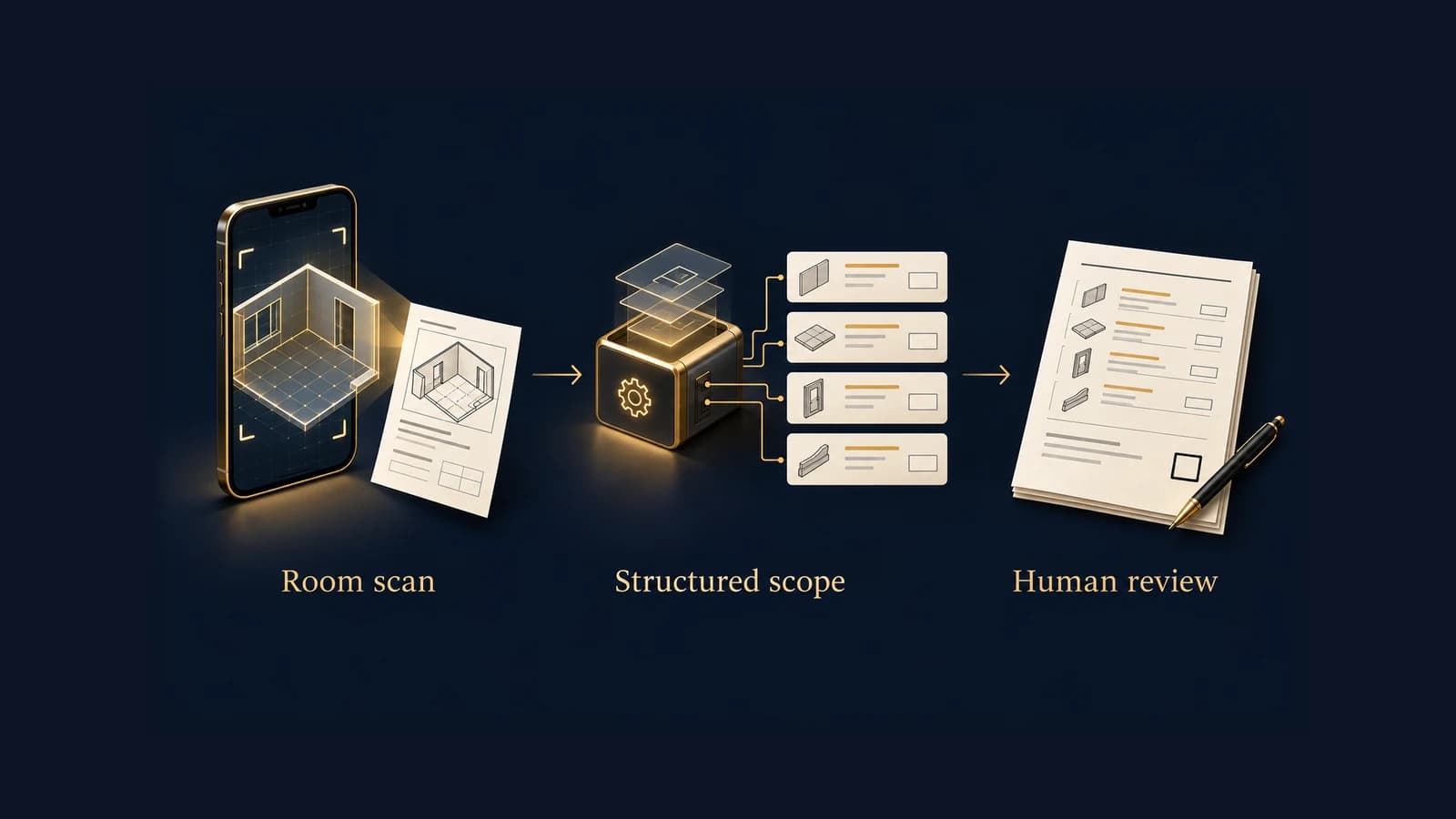
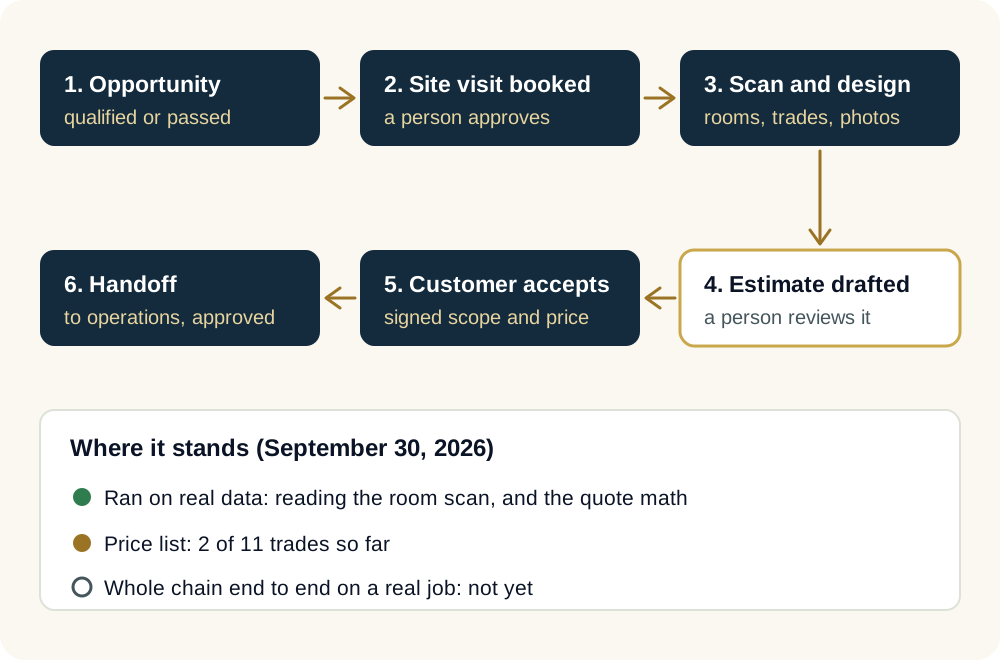
Diagram: a phone room scan becomes a structured scope, then an estimate that a person reviews.
The path this build is designed around: a room scan, a structured scope, and a person reviewing the estimate. As of September 30, 2026, it has not yet run end to end on a real job.

The waste is waiting, not estimating

Measurements sit until someone draws them up, prices sit until someone looks them up, and the customer waits on both. The time goes to the queue in front of one busy person, not to the arithmetic.

The person who runs the company's field operations put it in one line: the waste is waiting, not estimating. The arithmetic of an estimate is quick. The measurements sit until someone draws them up, the prices sit until someone looks them up, and the customer waits on both.

It is also the measure the field lead chose for the system: waiting time, rather than a count of estimates produced.

The chain, stage by stage

Opportunity, qualification, an approved site visit, scan and design with the trades, an estimate a person reviews, the customer's acceptance, and an approved handoff to operations. Each stage has an owner, and the approver changes with the job.

The build covers everything from a new inquiry to an accepted job handed to operations. A person approves at the points where money or a promise is at stake, and who that approver is depends on the job.

Diagram of six preconstruction stages: opportunity qualified, site visit booked with approval, scan and design, estimate drafted and reviewed by a person, customer accepts, handoff to operations. A status box says reading the room scan and the quote math have run on real data, the price list covers 2 of 11 trades, and the whole chain has not yet run end to end on a real job.
The six stages, with the honest status as of September 30, 2026.

Where the measurements come from

Each room is scanned with a phone at the site visit. The system reads that scan into rooms, walls and openings, and the quantities are computed by plain code, not guessed by a language model. A model is good at reading a messy note; it has no business doing square footage.

That reading step is one of two that already run on real data: it has read a real kitchen job's report, 18 rooms of it.

An estimate is only as good as the price list

The quote math is only as good as the prices under it. Today the written price list covers 2 of 11 trades, so the other nine stay with a person until they are priced.

The quote math passes its tests. The problem is underneath it: the written price list covers 2 of the company's 11 trades. An AI that fills the other nine with confident guesses would produce a clean-looking estimate that nobody should sign.

So until each trade is priced in writing, its lines stay with a person. That is slower on paper and much faster than rebuilding a customer's trust after a bad number.

Done means replaying a job you already won

Each step is finished only when it can reproduce a real job the company already sold and built. We picked six, from a kitchen and a bathroom to a small commercial fit-out.

Here is the uncomfortable part. As of this writing, the whole chain has not run end to end on a real job. Pieces pass their tests; the chain has not. I found that when I checked, and it changed how the work is defined.

Every stage is now finished only when it can replay a real job the company already sold and built. We chose six of different sizes, from a kitchen and a bathroom to a small commercial fit-out. If a stage cannot reproduce what actually happened on those, it is not done, however good its demo looks.

Why preconstruction is where AI pays first

Industry surveys put about a third of construction work hours into looking for information, conflict and rework. Much of that starts upstream, in a scope or estimate that was rushed or incomplete.

The industry numbers point the same way. FMI's survey work found construction teams spend about 35% of their work hours on non-optimal activities: looking for project information, resolving conflict and rework. McKinsey's research puts construction labor productivity growth at about 1 percent a year over two decades, against 2.8 percent for the world economy.

A good share of that rework starts upstream, in a scope that missed a room or a price that was a guess. Fix the handoff from site visit to estimate and every later stage starts cleaner.

What stays with a person, and when not to start here

Pricing judgment, design choices and the customer conversation stay human, and every estimate is approved before it leaves the building. And if your company does not yet write its trade prices down anywhere, start there, with a spreadsheet, before any AI. The system can only be as good as the list it reads.

Common questions

Answers to what people ask.

What is preconstruction in a design-build company?

Everything between a new inquiry and signed, scheduled work: qualifying the lead, the site visit, measurements and design, trade coordination, the estimate and the customer's acceptance. It is where the job's scope and price get decided.

Can AI write a construction estimate?

It can assemble a draft from measurements and a price list, and the quantities should come from plain code, not a model's guess. A person reviews and approves every estimate before a customer sees it, and any trade without a written price list stays a human line.

How do you test an AI estimating system?

Replay jobs the company already won. Feed each step the real inputs from that job and compare the output with what was actually sold and built. A step that cannot reproduce a won job is not done.

Do I need to replace my field-service software?

No. The chain works around the tools the team already uses. Connections need care, though: Jobber, for example, replaces its sign-in token every time it is used, so a careless test connection can force the office to sign in again.

Sources

Where this comes from.

Next step

Estimates stuck behind one busy person?

Bring one job you already won: the measurements, the photos and the final price. We will walk it through the chain with you and show which step is the real bottleneck.

Christopher J. Moreno

Written by

Christopher J. Moreno

Chris Moreno builds custom AI systems for business operations. His writing draws on the work behind these systems: intake, follow-up, document workflows, and the checks that keep people in control.

Published September 30, 2026 · Connect on LinkedIn

Our methodology

The Flo OS in practice

The approach behind this work follows the four phases of Flo OS, our operating methodology for turning messy business workflows into systems that run cleanly and compound over time.

See how we work →

Related reading

Keep reading.

All articles