Book a call ↗

Consulting method · 4 min read · September 29, 2026

Why We Partnered With Bridges AI: More Hands on the Build, the Same Accountability

Bridges AI, a New Jersey AI consultancy, announced a partnership with CMore Flo. Here is what that means for anyone we work with, and the three questions I would ask any firm, us included, when more than one company touches your build.

What should a business ask when more than one AI firm works on its build?

Ask three things before work starts: who is accountable for the result, what each firm can see and touch, and what you own and can run on the day of handover. CMore Flo and Bridges AI are partners, and each firm answers to its own clients for its own work.

When a client hires a small firm, the first worry is usually capacity: what happens when the one person who knows the system is busy? The second worry comes later, and it is worse: who else has been working on my system, and what could they see?

Bridges AI answered both publicly this week, and named us in it. This is our side of that answer, and a checklist you can use on anyone who bids your work.
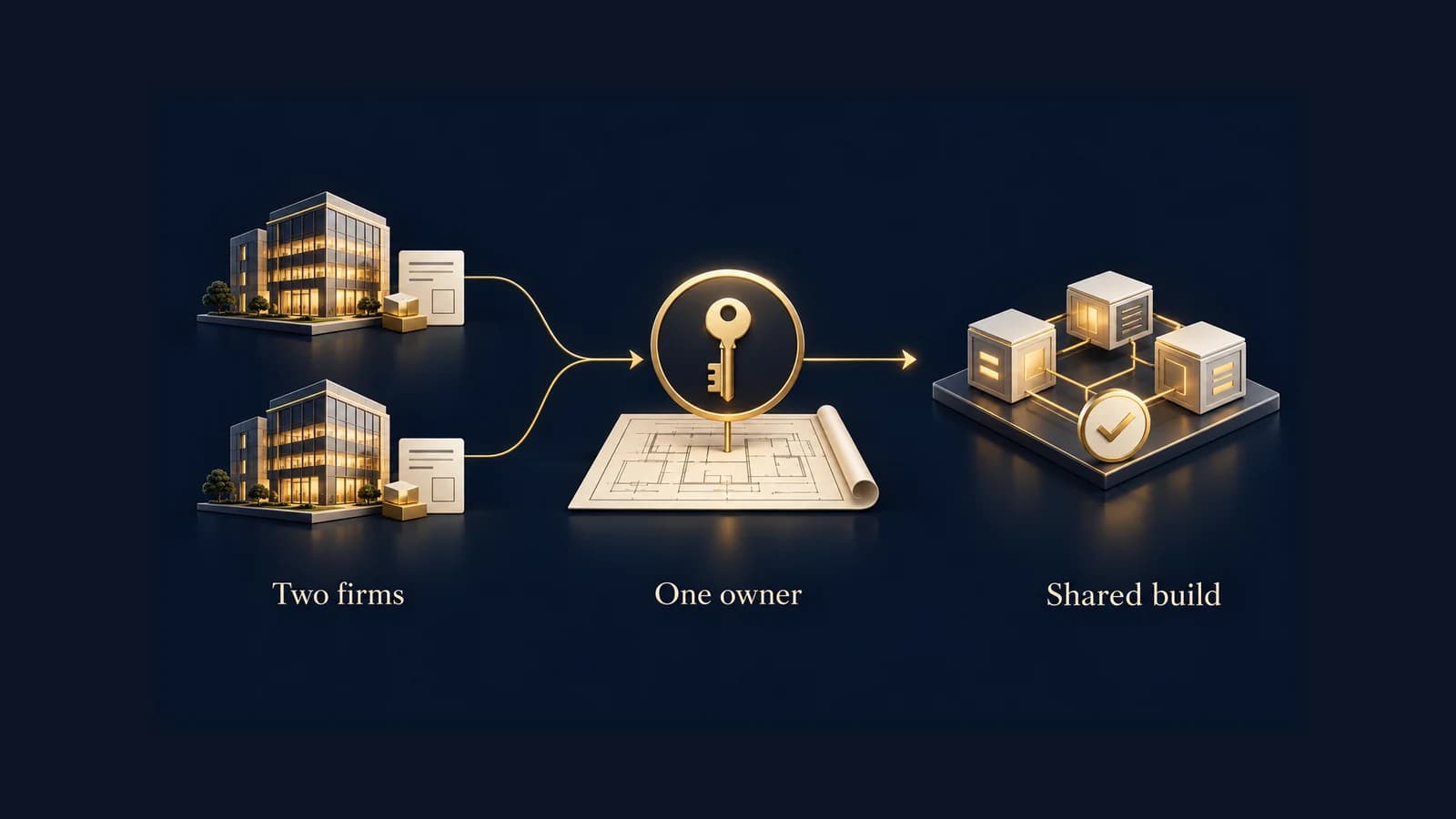

Diagram: two firms feed their work into one accountable owner, who delivers one shared build.
Two firms can work on one build. One owner answers for it.

What Bridges AI announced

On September 28, Bridges AI published a post naming CMore Flo as a partner. As they describe it, each firm can bring in the other's hands on a build, each stays accountable to its own clients, and neither hands off a relationship.

On September 28, Bridges AI, an AI consultancy in New Jersey, published why they partnered with an AI consulting firm in Tampa Bay. That firm is CMore Flo. As they describe it, the partnership is about build capacity: each firm can bring in the other's hands on a build, each stays accountable to its own clients, and neither hands off a relationship.

I confirm the partnership. What I will not do is restate their commitments as ours; their post speaks for how they run their practice, and this one speaks for mine.

Why the pairing makes sense

I build from Tampa Bay, and my flagship client, A&J Professional Services, is a roofer in New Jersey, where Bridges works. Their public work sits close to property data, with pages on real estate screening and tax assessment. Mine sits in commercial real estate deal review, construction and service businesses. Two small firms with overlapping ground and different home markets can cover for each other without either pretending to be bigger than it is.

Question one: who is accountable for the result?

One firm holds your relationship and answers for the outcome. Ask for the list of what done looks like and who signs off on it, in writing, before work starts.

One firm should hold your relationship and answer for the outcome, whoever writes a given piece. In my engagements that shows up as fixed modules, each with a written description of what done looks like, and acceptance that happens against that list. If a consultant cannot hand you that list, nobody is accountable yet.

Question two: what can each firm see and touch?

Every system has real data in it. Ask who can see it, how testing happens without touching real customers, and who holds the credentials, the access and the backups.

Every useful system has real customer data in it. When I prove a lead system for A&J, it runs on test phones, and real customers' numbers are not touched until a switch is deliberately turned on. For a real estate client, the agreement names who can query the data, who holds the credentials and who keeps the backups. Ask for the same, in writing, from anyone who will touch your build.

Question three: what do you own on handover day?

You should own your data, your rules and your outcomes, and be able to run the system without the people who built it. Ask what stays with the consultant and why.

You should own your data, your rules and your outcomes, and be able to run the system without the people who built it. The consultant may keep its methods, such as how it grades a system; that is fair, as long as it is written down. I made the longer case in own your intelligence before the models get gatekept.

AskA good answerA red flag
Who is accountable for the result?One named firm, with a written list of what done looks like"We all work together on it"
What can each firm see and touch?Named people, test data first, access and backups assigned in writingVague promises about security
What do you own on handover day?Your data, rules and outcomes, and a system you can run without usThe system only runs on the consultant's accounts
Three questions to bring to any first conversation with an AI consultant, including this one.

What does not change

I still answer to my clients for my work. Each client's own agreement still governs its data. If you already work with me, nothing about your project changes because of this post. And if you want to talk about a build, the booking link below goes to me.

Common questions

Answers to what people ask.

Is CMore Flo part of Bridges AI?

No. They are two independent firms, CMore Flo in Tampa Bay and Bridges AI in New Jersey, and they are partners. Each keeps its own clients, its own agreements and its own responsibility for its work.

Will another firm work on my project?

If another firm's hands would ever touch your build, you should hear it before it happens and be able to say no. Ask any consultant, us included, to put that in writing, along with what that firm could see.

Where does CMore Flo work?

Tampa Bay first: Hillsborough, Pinellas, Pasco, Polk and Manatee counties. We also work remotely; our flagship client, A&J Professional Services, is a roofing contractor in New Jersey.

Sources

Where this comes from.

Next step

Weighing more than one firm for a build?

Bring the three questions. We will answer them for your project on the first call, in writing if you want them that way.

Christopher J. Moreno

Written by

Christopher J. Moreno

Chris Moreno builds custom AI systems for business operations. His writing draws on the work behind these systems: intake, follow-up, document workflows, and the checks that keep people in control.

Published September 29, 2026 · Connect on LinkedIn

Our methodology

The Flo OS in practice

The approach behind this work follows the four phases of Flo OS, our operating methodology for turning messy business workflows into systems that run cleanly and compound over time.

See how we work →

Related reading

Keep reading.

All articles